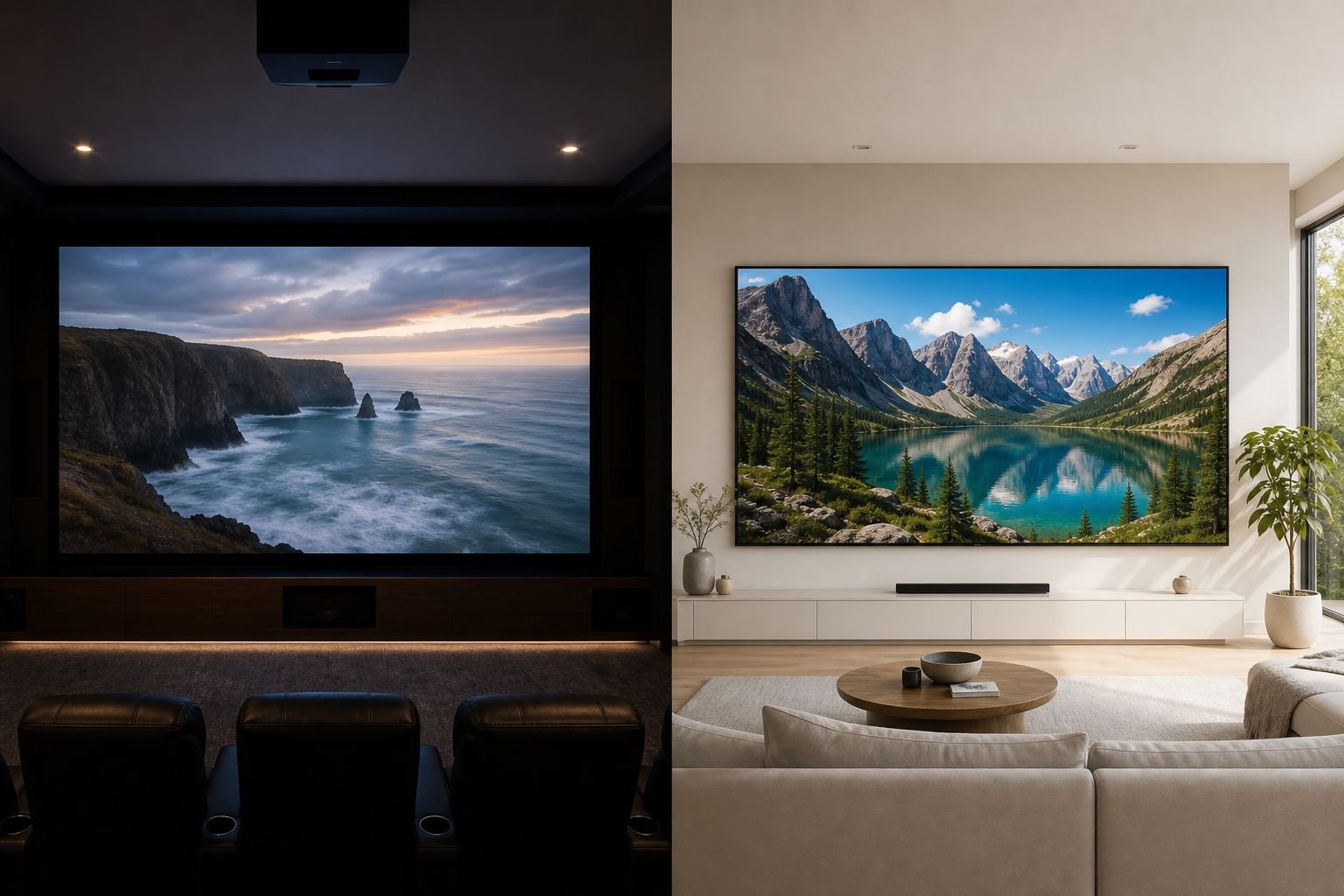
4K Projector vs 4K TV: Which Should You Buy?
The Core Question
Both 4K projectors and 4K TVs can deliver stunning images. The question isn't which technology is better — it's which is better for your specific room, viewing habits, and budget. This guide cuts through the marketing to give you a straight answer based on real-world UK usage.
Side-by-Side Comparison
| Factor | 4K Projector | 4K TV |
|---|---|---|
| Maximum screen size | 100–150"+ (no limit) | 85–97" (very expensive) |
| Cost per inch | Very low | High (especially 75"+) |
| HDR brightness | Lower (1,000–3,000 nits max) | Higher (up to 3,000+ nits for OLED/Mini-LED) |
| Black levels | Limited (grey blacks) | Excellent (OLED = true black) |
| Ambient light tolerance | Poor — needs darkness | Excellent |
| Installation | More complex (ceiling mount or shelf) | Simple (wall-mount or stand) |
| Maintenance | Lamp replacement (every 3–5 years) or laser (none) | None typically |
| Gaming | Input lag varies (20–50ms typical) | Lower input lag (1–5ms) |
| Best use case | Dedicated cinema rooms, evening use | All-purpose, any room |
When a Projector Wins
The projector's killer advantage is scale. A 100-inch projected image costs £400–800 in projector terms. The same screen size in a TV? You'd be spending £5,000–£10,000+ for a Samsung The Wall or comparable display. If screen size is your primary goal and you can control ambient light, a projector is the only sensible choice economically.
- Dedicated cinema room — if you have a room with blackout blinds or shutters, a projector transforms the space into a genuine cinema.
- Casual evening viewing — even a standard UK living room can work with a projector for films after dark with curtains drawn.
- Screen sizes above 85 inches — at this size, projectors are dramatically cheaper than TVs.
- Budget-conscious buyers — a £500 1080p projector on a 100-inch screen is far more cinematic than a £500 65-inch TV.
When a TV Wins
TVs are the more practical choice for most UK households. OLED panels in particular have reached a peak of image quality that projectors cannot match for HDR peak brightness and absolute contrast. Critically, TVs work in any lighting condition — a projector in a bright UK living room at noon is washed out.
- Daytime viewing — if you watch TV during the day without blackout blinds, a projector is impractical.
- Gaming — modern gaming TVs offer 1ms input lag and 4K/120Hz; most projectors can't match this.
- Small to medium rooms — a 65-inch OLED in a living room is more versatile than a 100-inch projection screen in the same space.
- HDR performance — OLED and premium QLED TVs deliver far better HDR peak brightness than most projectors at equivalent price.
"The best projector in the world cannot match an OLED TV for HDR peak brightness. But the best TV in the world cannot give you a 120-inch image in your lounge for £800." — EZ Audio Visual AV team
The Verdict for UK Buyers
Buy a TV if: you watch TV during the day, you don't have a room you can properly darken, you game seriously, or your preferred screen size is 65–77 inches.
Buy a projector if: you want a 90-inch+ image, you have or can create a darkened room, and your primary use case is evening film watching. The cinematic impact of a large projected image is genuinely special — nothing a TV can deliver comes close for sheer scale.
For many UK buyers, the answer is: a TV for everyday use and a projector for a dedicated or converted room. If budget forces a choice, consider what your primary use case is and how often you'll actually dim the room.
Content is for informational purposes only. Prices quoted are approximate and may change.